Chepstow’s identity has long been tied to the River Wye. From medieval wharves to modern distribution hubs, the town has repeatedly reshaped its economy without ever severing its connection to the water that first made it prosperous.
A Port of National Importance
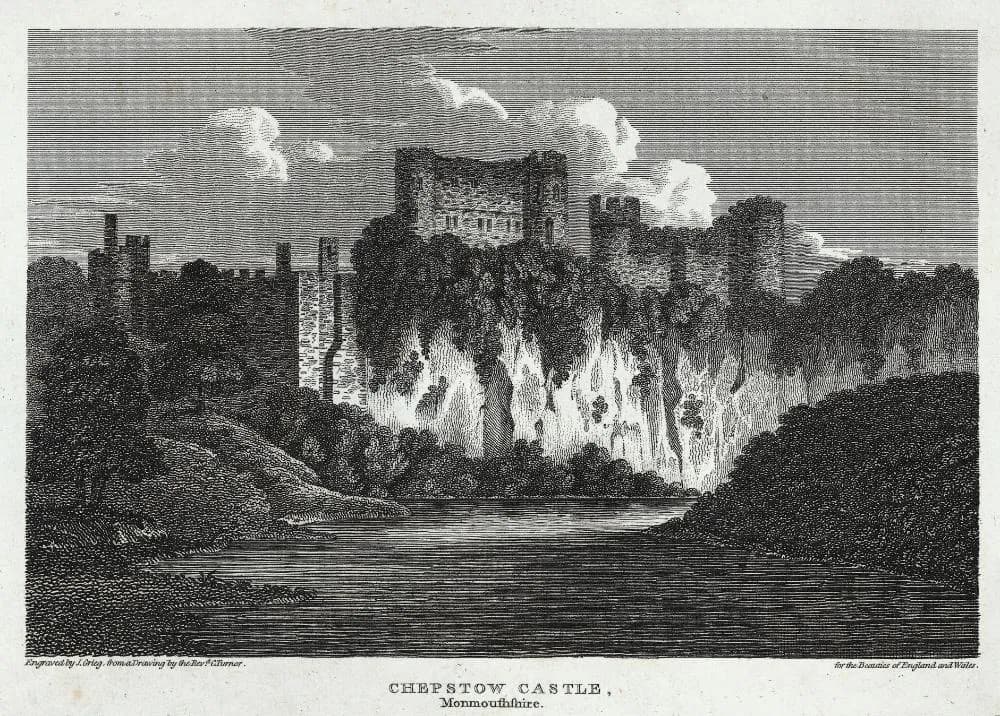
During the medieval period, Chepstow was the largest port in Wales. Vessels sailed from its quays to destinations as distant as Iceland, Turkey, France, and Portugal, carrying wine into the town and exporting timber and bark drawn from the Wye Valley and the Forest of Dean. The trade was substantial enough that wool and hides also featured in the cargo manifests, helping to fund the castle and the town that grew around it.
The Napoleonic Wars sharpened Chepstow’s strategic role. Timber for shipbuilding and bark for leather tanning became vital commodities. Mills on the Wye’s tributaries added wire and paper to the list of exports, giving the town a surprisingly diverse industrial base for its size.
By the 19th century, Chepstow had added shipbuilding to its portfolio. The town was also known for clocks, bells, and grindstones. Each product line reflected the skilled labour available locally and the raw materials that the river and surrounding forests could supply.
National Shipyard No. 1 and the Birth of Prefabrication
The First World War brought a dramatic shift in scale. National Shipyard No. 1 was established in Chepstow, where prefabricated ships were built for the first time. The War Glory was among the vessels launched from these yards, marking a milestone in British maritime engineering.
After the war, the shipyard did not simply lie dormant. It evolved into a centre for fabricating major engineering structures, laying the groundwork for the kind of heavy manufacturing that would define the town for much of the 20th century.
The Mabey Group and a Brief Era of Turbines
The Mabey Group, which developed on the former shipyard sites, became one of the area’s most significant employers. At the Newhouse Farm industrial estate, the company assembled wind turbine towers, placing Chepstow at the literal forefront of renewable energy manufacturing.
That experiment proved short-lived. In July 2015, the Newhouse Farm site closed, with the loss of 125 jobs. The UK government’s decision to end subsidies for onshore wind generation removed the economic foundation for the work, and Chepstow’s turbine era came to an end almost as quickly as it had begun.
The closure illustrated how vulnerable specialised manufacturing can be to policy shifts made hundreds of miles away in Whitehall. For the workers and families affected, it was a sharp reminder that industrial reinvention is rarely a smooth or predictable process.
Brushes, Tensile Structures, and Smaller Trades
Chepstow’s industrial story is not only one of large-scale engineering. The Dendix brush factory, which produced industrial brushes and the bristled surfaces used on artificial ski slopes, operated in the town for decades before relocating to a new site near the M48 in 2011. The company, now known as Osborn-Unipol, remains a local employer.
Architen Landrell, a manufacturer of tensile architectural structures, also had a presence in the town until announcing its closure in December 2015. Alongside these firms, MVM Films, a distributor of Japanese animated films, demonstrated that Chepstow’s commercial reach has often extended well beyond its immediate geography.
Infrastructure as Economic Engine
The opening of the Severn Bridge in 1966 transformed Chepstow’s prospects. Road and rail links to Bristol and Cardiff turned the town into a significant commuter base, reshaping its population and its housing market. The bridge did not merely connect two banks of the estuary; it reoriented Chepstow’s economy towards the service sector and towards the daily rhythms of workers travelling east and west.
In 2004–05, more than £2 million was invested in regenerating the town centre. The scheme won national awards for design quality, though it also drew local criticism over cost. Riverside landscaping tied to flood defence works has since altered the southern edge of the town, creating public space out of infrastructure necessity.
The Modern Landscape
Today, Chepstow’s economy rests on a mixture of service industries, tourism, and logistics. Newhouse Farm remains a major distribution centre, while smaller industrial estates in Bulwark and near the railway station accommodate a range of businesses. The Chepstow Chamber of Commerce continues to advocate for local firms, and the town’s large commuter population ensures a steady flow of spending power through its shops and restaurants.
In 2018, Chepstow was declared the first "Plastic Free Town" in South Wales by Surfers Against Sewage. The accreditation was a symbolic statement rather than an industrial strategy, but it signalled a community willing to align its identity with environmental credentials, even as the large-scale renewable energy manufacturing that once seemed its future had already departed.
Looking Forward
Chepstow’s industrial history is not a straight line from timber to turbines. It is a series of pivots: from medieval port to 19th-century manufacturer, from wartime shipyard to post-war engineering hub, from heavy industry to commuter town and distribution centre. Each phase built on the physical advantages of the site — the river, the road, the rail, the proximity to the Forest of Dean and the Severn Estuary — while responding to external forces that the town could influence but never control.
Whether Chepstow will host another generation of green energy manufacturing is uncertain. What the record shows is that the town has repeatedly demonstrated the capacity to adapt. That adaptability may yet prove its most enduring industrial asset.