Piercefield House, standing on a clifftop 1.5 miles north of Chepstow, became one of Britain's earliest and most influential examples of picturesque landscape design. The estate drew artists, writers, and tourists throughout the late 18th and early 19th centuries, including J.M.W. Turner, who painted in the Wye Valley during the peak of the Picturesque movement.
Valentine Morris and the Picturesque Vision
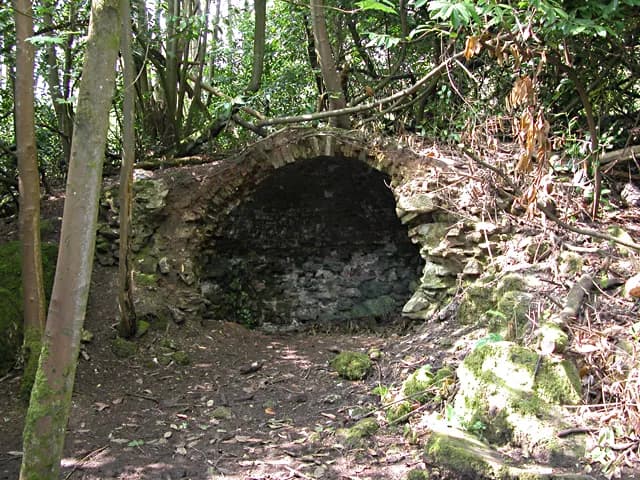
The transformation of Piercefield began with Valentine Morris (1727–1789), who inherited the estate in 1743 and moved there with his family in 1753. Morris developed Piercefield Park as one of the earliest examples of picturesque landscaping in Britain, creating woodland walks featuring a grotto, druid's temple, bathing house, and giant's cave. He established viewpoints along the clifftop above the River Wye that framed the landscape according to the emerging aesthetic principles of the Picturesque movement.
The Picturesque, introduced into English cultural debate in 1782 by clergyman and artist William Gilpin, defined a "peculiar kind of beauty, which is agreeable in a picture"—characterised by roughness, sudden variation, and irregularity of form. Gilpin's Observations on the River Wye established the Wye Valley as an area rich in picturesque scenes. He wrote in 1770 that "Mr Morris's improvements are generally thought as much worth a traveller's notice as anything on the banks of the Wye."
Morris's financial difficulties—stemming from gambling, business dealings, and a failed by-election for Monmouthshire in 1771—forced him to sell Piercefield in 1784. He died in London in 1789 after imprisonment for debt.
The House and Its Architecture
The current Piercefield House was built between 1792 and 1799. The central block was designed by Sir John Soane according to architectural historian Nikolaus Pevsner, though Cadw attributes the design to George Vaughan Maddox. The east and west pavilions were designed by Joseph Bonomi the Elder between 1795 and 1799.
The property passed through several notable owners. George Smith, a Durham banker, purchased the estate in 1785 for £26,200. Colonel Mark Wood, MP for Newark-on-Trent, acquired it in 1794. In 1802, Nathaniel Wells purchased Piercefield; he was the son of a slave owner and an enslaved mother, and became the first black sheriff of Monmouthshire.
The Wye Tour and Chepstow
Piercefield became a essential stop on the Wye Tour, which operated from 1782 until approximately 1850. The tour began at Ross-on-Wye, with travellers proceeding by pleasure boat—at peak popularity, eight to ten boats departed daily at a cost of three guineas per passenger per day. The route passed Goodrich Castle, ironworks at New Weir, and Symond's Yat before reaching Monmouth on the first night.
The second day brought tourists through Piercefield Park before continuing to Tintern Abbey and concluding at Chepstow. The tour gained particular popularity during the Napoleonic Wars (1790s–1815) when travel to continental Europe was not an option, effectively replacing the Grand Tour for British travellers.
Notable visitors to Piercefield included poet Samuel Taylor Coleridge, who described the view as "Oh what a godly scene....The whole world seemed imaged in its vast circumference." Scientist Joseph Banks wrote that he was "more and more convinced that it is far the most beautiful place I ever saw."
Turner and the Wye Valley Artists
J.M.W. Turner visited the Wye Valley in 1794, painting The Chancel and Crossing of Tintern Abbey, Looking towards the East Window in watercolour and graphite. The work is now held by Tate Britain as part of the Turner Bequest. While Turner's specific paintings of Piercefield House itself are not documented in available sources, the estate formed part of the landscape that attracted artists and tourists during the height of the Picturesque movement.
The Wye Tour also influenced Romantic literature. William Wordsworth wrote "Lines composed a few miles above Tintern Abbey" in 1798 after visiting the area.
The Piercefield Walks Today
Piercefield and the Wyndcliff were jointly listed at Grade I on the Cadw/ICOMOS Register of Parks and Gardens of Special Historic Interest in Wales in February 2022. The estate's picturesque features—including the grotto, alcove, giant's cave, and the Platform—are scheduled monuments. The footpaths now form part of the Wye Valley Walk and were reopened to the public in the 1970s.
The house itself stands as a roofless shell, with floors collapsed. It is Grade II* listed and has been owned since the early 21st century by London property developers David and Simon Reuben. Emergency stabilisation work was carried out between 2008 and 2009, though the condition continues to deteriorate. SAVE Britain's Heritage launched a campaign to save the structure in July 2013.
The Royal Commission on the Ancient and Historical Monuments of Wales has described Piercefield as "the par excellence outstanding example of an early sublime landscape."